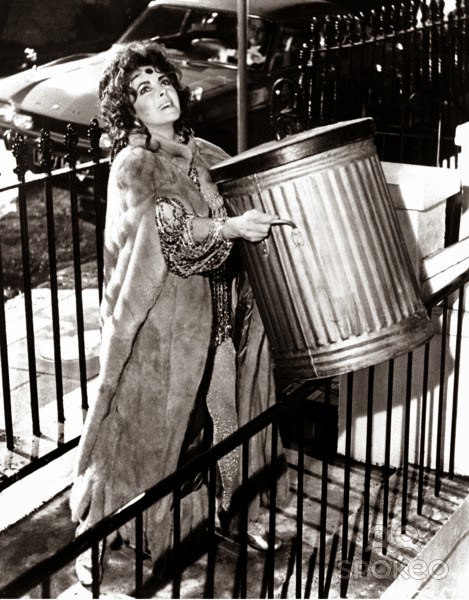
I’ve always said that some great roles rub off on the actors who play them. Bette Davis stayed Margo Channing in just about every role after All About Eve. Yul Brynner remained the supercilious King of Siam for life, from the day he first originated the role onstage. Faye Dunaway has continued to channel Joan Crawford more than 30 years after Mommie Dearest. And Elizabeth Taylor’s post-1966 roles all contain echoes of her Oscar-winning turn as Martha in Who’s Afraid of Virginia Woolf...including this darkly comic, little-seen gem.
One of the great Taylor performances: Elizabeth as Zee Blakely
Zee (Elizabeth Taylor) and Robert (Michael Caine)
In fact, X, Y and Zee (1972) is somewhat like a London mod version of Virginia Woolf in psychedelic technicolor, a portrait of a crumbling marriage, with the handsome and talented Michael Caine standing in for Richard Burton in the George-like role of Zee’s passive-aggressive husband. When Robert (Caine) begins a surreptitious affair with Stella (Susannah York), you-know-who finds out and an ugly game of cat and mouse begins, culminating in hurt feelings, high drama and sweet revenge.
Stella (Susannah York) tolerates Zee's antics
York and Caine underplay admirably as the adulterous lovers. Caine’s qualms about abandoning his marriage foreshadow his comic Oscar-winning turn as the adulterer in Woody Allen’s Hannah and Her Sisters two decades later. And as the hard-to-read, sexually confused Stella, Susannah York pays homage to one of her own iconic roles, the lesbian love interest in The Killing of Sister George.
The charming and charismatic Caine, so adept in light comedy, reveals brilliant flashes of a menacing dark side as Robert, particularly while sparring with Taylor, who unrelentingly baits and taunts him until he explodes in moments of uncontrolled rage and fury.
Zee and Robert, or George and Martha?
Robert loses his patience
But, of course, the film belongs to Elizabeth Taylor as Zee, a heightened version of a woman scorned. Zee is mean, nasty, vicious, domineering, childish--a replay of Martha but with an even greater measure of madness. No one plays bonkers like Taylor, as fans of films like Night Watch, Raintree County and Suddenly Last Summercan attest…and as Zee Blakely, she pulls out all the stops. Truly, as the aptly named title character, she runs the gamut of emotions from A to Zed.
Here, La Liz is grotesque and flamboyant, as foul-mouthed as Martha but now glammed up in full-color splendor, flouncing about in jangling jewelry, powder blue eyeshadow and flowing caftans that barely disguise her ever-more-Rubenesque proportions. Camp yes; over-the-top, sometimes, but make no mistake: This is a bravura star performance by Taylor, a fine actress who redeems the villainy of her character with a generous dose of wry humor and a surprising vulnerability that ultimately leaves the audience on her side, despite Zee’s appalling behavior.
Zee makes some noise
Zee and Gordon (John Standing)
Stella, Robert and Gladys (Margaret Leighton–not Audra Lindley)
Obviously glorying in cinema’s newfound freedom since the abolition of the production code and establishment of a movie rating system, director Brian G. Hutton goes out of his way to make sure X, Y and Zee is hip and (to use the vernacular of the day) “with it”. The language is frank and salty. Hutton takes pains to capture the mood of the early 70s zeitgeist—the hedonistic fervor of the sexual revolution in full swing and burgeoning “Me” decade—particularly in the party scene at the beginning of the film hosted by an eccentric socialite (a marvelous cameo by English theater veteran Margaret Leighton) . This is also one of the first films to use the character of a flagrantly gay confidante (John Standing) to move the plot forward and provide exposition. But alas, Zee, an equal opportunity psychotic, is as nasty to him as she is to everyone else she comes in contact with.
For Elizabeth Taylor fans, this is the perfect opportunity to enjoy the actress in one of her great unsung roles, ably assisted by great costars, in a campy, colorful, rousing rendition of love gone wrong. And the film’s startling conclusion features a neat twist that makes it all worthwhile.
In every life, there comes a moment of decision, a crossroads. When that choice is made, there is no turning back. Life takes a different direction, and we must live with the consequences. This is The Turning Point (1977).
For his intimate look behind the scenes of the competitive world of professional ballet, director Herbert Ross assembled a stellar cast, headed by two of Hollywood’s biggest stars. Both Shirley MacLaine and Anne Bancroft were over the age of 40 and battling to secure leading roles in film as a new breed of stars began to dominate 1970s cinema. This wonderful film won both women enough accolades to bolster their superstar status and secure their career longevity.
Shirley MacLaine as Deedee
Anne Bancroft as Emma
As DeeDee, Shirley MacLaine has one of her most memorable roles. Though many may prefer MacLaine’s more iconic performances in earlier films including The Apartment and Sweet Charity, or her later triumphs in Terms of Endearment and Postcards from the Edge, I find this mid-life MacLaine character full of touching vulnerability and sympathetic insecurity. DeeDee is filled with regret at dreams that never came true, a frazzled hausfrau with a house full of kids almost ready to leave the nest. She’s put on a few pounds since the days she studied to be a prima ballerina, and when the American Ballet Company comes to town, she finds herself face to face with her best friend and rival Emma, now a legendary star. When DeeDee’s talented daughter Amelia, a budding ballerina, is invited to join the company in New York, the two old friends have the opportunity to settle a few old scores.
Anne Bancroft is commanding as Emma, the aging superstar who must fight to keep her place in the company despite the newcomers who can now out-dance (and outshine) her. Slim, angular and elegant, Bancroft carries herself with a dancer’s grace and poise, but her lack of dance ability is obvious; we never get to see the great talent that has made Emma a legend. Bancroft’s brief “performances” in the dance sequences show the actress “acting up a storm,” but with cheated camera angles and nary a pirouette. Acting-wise, though, Bancroft is strong, and her scenes with MacLaine crackle with chemistry and excitement as a lifetime of regrets and recriminations mount, and the two vie for the affection of Amelia.
Leslie Browne as Amelia
Mikhail Baryshnikov as Yuri
Tom Skerritt as Wayne
Reminiscent of those old “women’s pictures” of the 1930s and ‘40s like Auld Acquaintance and In This Our Life, these two strong female characters carry the picture, assisted by dancer Leslie Browne in her film debut as Amelia. The male members of the cast--including Tom Skerritt (Alien) as DeeDee’s husband, another former dancer; James Mitchell (All My Children) as the company’s famed choreographer; and Mikhail Baryshnikov as Amelia’s dashing Russian dance partner and love interest--are all excellent but merely incidental to the proceedings. Together, MacLaine and Bancroft form the engine that makes the sparks fly.
Both MacLaine and Bancroft received Academy Award nominations that year in the Best Actress category, but as so often happens, neither won. (Diane Keaton beat them both, winning the award for Annie Hall.) Also nominated that year in the supporting categories were dancers Browne and Baryshnikov, more for their glorious dancing than for their acting prowess. (Vanessa Redgrave and Jason Robards won those awards, both for their performances in the film Julia.)
Director Ross skillfully avoids focusing on Emma's feet...
A passionate pas de deux for Leslie and Mischa
The raison d'etre for ballet - lots of skin and tights
What sets this film apart from mere well-acted soap opera is its loving spotlight on the art of the dance. Director Herbert Ross, ably assisted by then-wife Nora Kaye (he later married Jacqueline Kennedy Onassis’s sister Lee Radziwill), creates a visual valentine to the art of the ballet, capturing on film some of the most legendary talents in the field and sharing his passion for this somewhat elitist and recherche medium with a mass audience. Baryshnikov in particular has some astonishing moments. At the peak of his physical and technical talents, he is a passionate young god leaping divinely and defying gravity at every turn.
Herbert Ross, whose first big film assignment was choreographing the musical numbers for Funny Girl in 1968, apparently used some unorthodox means for creating dramatic tension between his two leading ladies in The Turning Point. As a prelude to their famous hair-pullling, cat-scratching rooftop battle royale, MacLaine and Bancroft share a scene in a quiet bar and begin to verbally spar, culminating in Bancroft tossing a drink into MacLaine’s obviously startled face. MacLaine was indeed nonplussed, since it was a gesture that Ross had secretly worked on with Bancroft to elicit MacLaine’s raw and naked emotional response. She never quite trusted the director again after that scene, though they would work together again.
The famous cat-fight
MacLaine skewered Ross’s sadistic techniques for getting a performance out of his actresses, both on this film and in Steel Magnolias a dozen years later. In her memoirs, she wrote that he literally brought both Darryl Hannah and Dolly Parton to tears. Not Shirley, though. She was now wise to his flim-flam.
Director Ross, Nora Kaye and Shirley MacLaine
The Turning Point is a great opportunity to see two fine actresses at the top of their game, as well as an unparalleled look at the world of ballet, both on and off the stage.
An awkward plain-Jane spinster, heiress to a vast fortune, meets a handsome and debonair yet penniless younger man. Fueled by love, the formerly introverted and obedient Catherine defies her stern and taciturn father and risks disinheritance to win her beloved Morris. But matters of the heart are rarely resolved so simply, especially when money is involved.
For The Heiress (1949), based on the novel Washington Square by Henry James and adapted into a successful play by Ruth and Augustus Goetz, legendary director William Wyler assembles a stellar cast to create one of the cinema’s most unforgettable and heart-rending love stories.
Montgomery Clift as Morris Townsend
Arrestingly handsome, with his famously chiseled features and a soulful aura that belies his character’s possibly mercenary intentions, Montgomery Clift is perfectly cast as Morris Townsend, the glamorous stranger who comes to call on the maiden heiress Catherine Sloper. Even if Morris is in fact merely an opportunist after the Sloper fortune, he is so attractive, solicitous and romantic in his wooing of Catherine that the audience believes their marriage could indeed prove harmonious and result in a happy ending for both characters. This defining early performance sent Clift into the superstar stratosphere and made him an international heartthrob, with his potent combination of acting talent and physical beauty.
Olivia deHavilland as Catherine Sloper
Far from unlovely herself, Olivia deHavilland transforms herself skillfully into the graceless ugly duckling Catherine, courageously using the obvious age difference between herself and Clift to underline her character’s undesirability. It’s a credit to deHavilland, a great beauty and longtime screen paramour of heartthrob Errol Flynn, that she manages to convince the audience of her utter lack of attractiveness--such a handicap, in fact, that other characters in the film literally gasp when they learn that Morris is wooing Catherine. Nevertheless, deHavilland is completely sympathetic and heartbreakingly vulnerable in the role of Catherine, which makes her eventual transformation into a hard and cynical simulacrum of her father all the more startling. For this performance, Olivia deHavilland won her second Academy Award as Best Actress (she had earned the first just three years earlier, for To Each His Own).
Olivia lets Monty be the pretty one
The supporting performances are equally striking and memorable. Scene-stealing actress Miriam Hopkins, who sparred so brilliantly with Bette Davis in The Old Maid and Old Acquaintance (as well as off the screen), is now relegated to the character role of Catherine’s vivacious aunt, which of course she plays to the hilt. Hopkins is prattling, frenetic and nearly over the top, but lends a welcome dimension of humor to this romantic melodrama.
Hopkins deftly upstages her costars
Richardson gives the lovers a frosty reception
Sir Ralph Richardson, one of the most celebrated British stage actors of the 20th century, is coldly and clinically effective as the smug and self-possessed Dr. Sloper, highly respected in New York society but prone to offering left-handed compliments and nasty but veiled remarks to his only child, who lives only to please him. Sloper’s own disillusionment is based on the long-ago loss of his beautiful and virtuous wife, the memory of whom their daughter can never measure up to. Richardson’s distinctive speaking voice, with its peculiar inflections and trills, is somewhat stagy but absolutely appropriate in his role as the pompous and humorless society doctor who threatens to cut Catherine off without a penny if she marries Morris.
Interestingly, there are no hard-and-fast resolutions to the story or answers to its big questions: Is Dr. Sloper right? Is Morris purely mercenary? Does he love Catherine at all? Should Catherine take whatever happiness, real or imagined, that she can get? Is Catherine justified in her final decision? Each viewer is allowed to form his or her opinion, and the film does not contradict the watcher’s personal viewpoint.
Thanks to the literate script, compelling performances and brilliant direction, The Heiress is an absorbing and affecting film, worthy of its status as an enduring classic.
Here’s a film that promises oodily, oodily, oodily, oodily fun fun fun, according to the Gwendolyn Sanford tune that plays under the opening credits. The kind of oodily fun that may make some viewers squirm in their seats.
You can look at Chuck & Buck (2000) in two ways--as a quirky, offbeat love story, or as the dark and disturbing tale of a relentless stalker and the enigmatic object of his obsession. This strangely entertaining film works on both levels.
Possibly autistic, definitely obsessive, Buck (Mike White) has led a sheltered life as caregiver for his ailing mother, who has just died. He moves to L.A. to seek out his childhood friend Chuck Sitter (Chris Weitz), who moved away when both were still boys. Trapped in a perpetual childhood surrounded by toys and stuffed animals, Buck is ill at ease in the “real world” and longs for the days when he and Chuck created a fantasy world of their own.
Mike White as Buck
Chris Weitz as Chuck
But Chuck has erased his childhood identity completely--he’s now no longer Buck’s BFF Chuck at all but Charlie, a successful, seemingly self-assured man with a beautiful fiancee, a high-powered career as a talent agent and a showplace of a home--a typical Hollywood narcissist. And he wants absolutely nothing to do with his socially awkward, embarrassingly blunt childhood buddy. But that doesn’t stop Buck.
And you can’t blame Charlie’s reticence, especially when Buck shows up at his door unexpectedly and suggests that the two resume their secret childhood games, including a round of the old “Chuck and Buck s*ck and f*ck,” with Charlie’s fiancee Carlyn (Beth Colt) in the next room.
Buck’s hopes for a reunion with Chuck— hanging out, climbing trees, and playing secret sex games—are dashed when Charlie is cold and unresponsive and avoids him like the plague. But Buck will not be ignored and begins to stalk Charlie and Carlyn, calling and hanging up repeatedly and even peeping through the window to watch the couple make love.
Lupe Ontiveros as Beverly
Maya Rudolph as Jamilla
But despite Buck’s displays of creepy and perverse behavior, Mike White (who also wrote the script) makes his protagonist ultimately sympathetic. The audience feels Buck’s sense of loneliness, isolation and desire to be loved and to belong. Throughout the film, Buck struggles to make sense of his situation, reaching out to others and exorcising his demons by writing a play about his childhood relationship with Chuck. White and director Miguel Arteta tell the story completely from Buck’s point of view, and the plot’s surprising twists vindicate the character in the end, despite his obsessions and aberrations.
Buck and Carlyn (Beth Colt)
Buck and Sam (Paul Weitz)
Chris Weitz is suitably inscrutable in his role of the cool and aloof Charlie/Chuck. Chris’s brother Paul Weitz takes the role of the moronic actor hired by Buck to play the surrogate for Chuck in Buck’s fairy tale play. (The Weitz brothers’ mom happens to be Susan Kohner, Academy Award nominee for the movie classic Imitation of Life.)
Standout supporting performances add heart, soul and humor to the proceedings. The wonderfully down-to-earth Lupe Ontiveros (Real Women Have Curves, Desperate Housewives) is endearing as Beverly, the theater house manager whose crusty and cynical exterior protects hopes and dreams for creative achievement that are unlocked by Buck and his strange play.
Charlie’s beleaguered assistant Jamilla is played perfectly by the talented and expressive Maya Rudolph (of Saturday Night Live fame), who can convey more with a roll of her eyes than most actors can do with a five-minute monologue in extreme close-up. When Buck bursts into tears when Chuck refuses to see him, Jamilla is shattered as well, her eyes welling up with tears of her own.
This unusual indie effort led many of its participants to mainstream success. Today, Mike White is well known as the writer and cocreator of the critically acclaimed Showtime series Enlightened starring Laura Dern. The Weitz brothers are the successful producers of films including About a Boy and the American Pie series. Rudolph is now a full-fledged movie star, thanks to her appearances in big hits like Bridesmaids. But they first made their marks by taking chances and pushing the creative envelope to expand the scope of film’s examination of the human experience.
Chuck & Buck is definitely oodily fun, fun, fun for film lovers...yeah.