
The recent death of music legend David Bowie at the age of 69 signaled the end of an era; the loss of a great talent and one of the most influential pop culture icons of our time. Though he was 69, the youthful, impish Bowie appeared never to have grown old. To the end, he remained a music industry sex symbol, ever hip and au courant.
Bowie was the chief inspiration of master filmmaker Todd Haynes for his glam rock fantasia Velvet Goldmine (1998). Goldmine traces the life of a famously bisexual pop star as seen through the eyes of one of his fans, once a London mod rocker and now a tabloid writer in a grim, gray 1984 New York that is positively Orwellian in its dull conformity, devoid of color and imagination. But the joy and excitement of that glittering bygone era are eternally incandescent.
 |
| David Bowie as Ziggy Stardust |
Much of the film is gleaned from the story of a working class London lad who turned pop culture on its ear with his bold androgyny and visions of space-age grandeur. Haynes was largely inspired by David Bowie’s Ziggy Stardust albums, relying upon many of Bowie’s songs and lyrics to tell the story in the first draft of his screenplay.
The character of Brian Slade aka Maxwell Demon is an obvious homage to the Ziggy Stardust alter ego of notorious showbiz chameleon Bowie. (Indeed, one of Maxwell Demon’s incarnations is a glitteringly reptilian sex symbol of a lizard.) Later, when it’s revealed that Slade has become the toothsome 1980s pop star Tommy Stone, we’re reminded of Bowie’s clean-cut, tuxedo-clad, commercially successful “Let’s Dance” career phase.
 |
| Jonathan Rhys Meyers as Brian Slade |
But David Bowie was of zero help to Haynes, refusing to allow the filmmaker to use any of his songs in the film and forcing Haynes and his the creative team to search frantically for music (both old and new) that would fulfill Haynes’s vision and aid the narrative.
The roadblock turned out to be a creative challenge that Haynes and company turned into a triumph. Musical contributors to the soundtrack included Lou Reed, Brian Eno, Bryan Ferry and members of The Stooges, Radiohead, Roxy Music and Sonic Youth. The songs used in Goldmine work perfectly in the scope of this epic film. That most are not so well known turns out to be a plus.
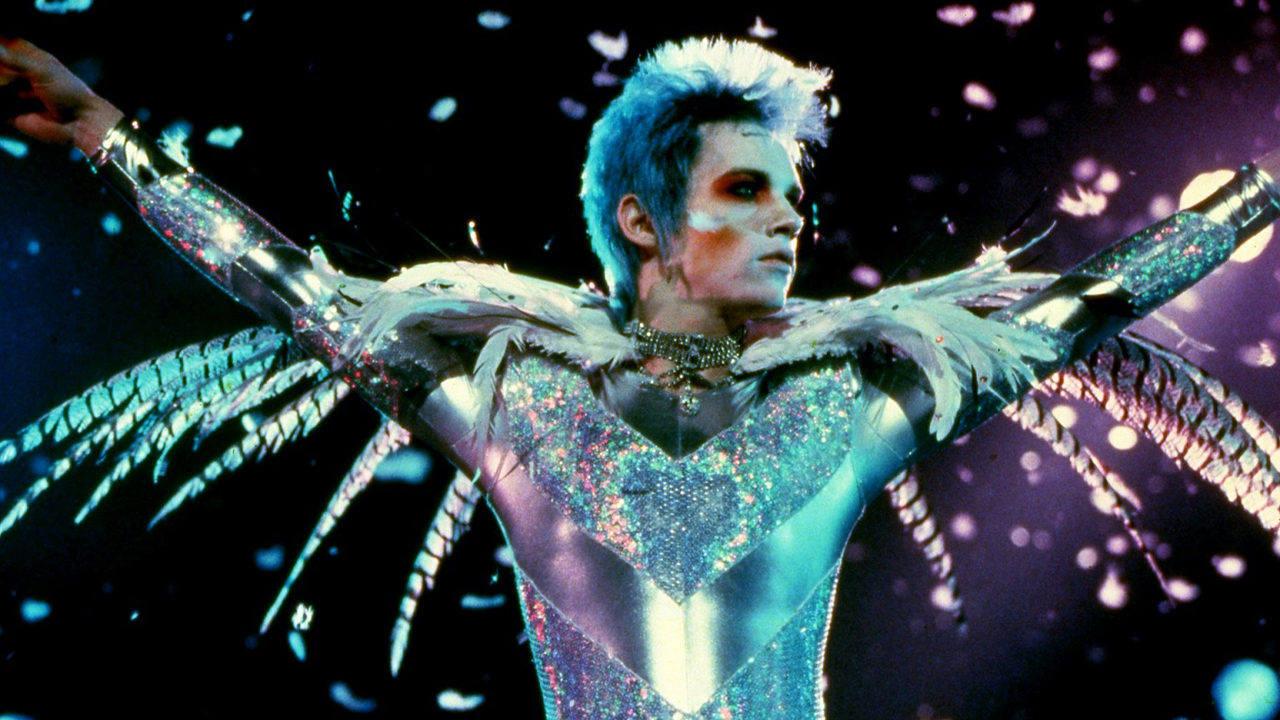 |
| "For once there was an unknown land, full of strange flowers and subtle perfumes, a land of which it is joy of all joys to dream, a land where all things are perfect and poisonous..." |
The unfamiliarity of the songs allows the music itself to take a secondary role to the thrust of the narrative. The film’s rich imagery and spectacle, and most importantly, its multilayered storyline, complex characters and relationships (and unforgettable performances) take center stage. In Velvet Goldmine, Haynes strikes gold with his own inventive, exciting, touching and absorbing storytelling. (And ultimately, the movie soundtrack has proven to be musically memorable as well in the years since it was first released. )
Made in the U.K., Goldmine has the feel of an authentically British film of the early 1970s, springing from the mind of a very inventive American writer and director. An exhaustive researcher who immerses himself in his subject matter and excels at period pieces, Haynes helmed the brilliant miniseries of Mildred Pierce, and the Douglas Sirk homage Far From Heaven as well as the recently acclaimed 1950s lesbian drama Carol.
 |
| Christian Bale as Arthur Stuart |
In Goldmine, Haynes and his team accurately recreate mod London at the crux of the swinging sixties into the superstar seventies. Oscar-winning costume designer Sandy Powell (Shakespeare in Love, The Aviator) and production designer Christopher Hobbs and art director Andrew Munro reveal their penchants for painstaking period detail, as well as a talent for wildly imaginative tableaux and scenarios for the dreamlike musical sequences.
Velvet Goldmine perfectly captures a particular moment in music history, but it is so much more--it’s a sprawling masterwork on the nature of art itself. Haynes, not content with capturing the glitter rock era alone, reaches all the way back to the legend of Oscar Wilde and the English music hall era for evidence of primitive precursors of “glam”, and propels us forward into outer space and other dimensions of reality to flesh out his themes on the origins of art, creativity and freedom of expression. It’s a visual, intellectual and musical feast.
 |
| Toni Collette as Mandy Slade |
There are too many dazzling and dizzying moments in Velvet Goldmine to describe them all, but a few of its more intimate moments reveal the film’s unique spirit and intentions. The glammed-up Ken dolls used to portray some of Curt and Brian’s intimate private moments (as imagined by their young fans) is storytelling innovation at its best, and a brief homage to Haynes’s own Karen Carpenter Story (in which he told the entire story of the bulimic singer’s tragic life using Barbie dolls).
 |
| "The Ballad of Maxwell Demon" album |
The sequence in which Arthur purchases the “Ballad of Maxwell Demon” record album and lay on the floor of his room with soda and chips to listen, flipping through a fan pop magazine, is particularly evocative of a long-ago 1970s teenage ritual. The album lays open on the floor beside him, the lush, erotic photography and music taking him on a romantic flight of fancy. Somehow, Haynes manages to capture the feel and even smell of the vinyl, and the once-familiar “pop” of needle hitting record as the music begins on the hi-fi.
 |
| Ewan McGregor as Curt Wild |
The film owes as much to its wonderful cast as to its innovative production design and literate script. Jonathan Rhys Meyers, (just 23 when he undertook this career-making role) is chillingly effective as icy pop prince Brian Slade, who must fake his own death in order to rid himself of the Maxwell Demon persona. Indeed, Brian is ruthlessly ambitious and cold as ice as he drops his kindly first manager (Michael Feast) without a qualm in order to climb the ladder to legend and infamy. (Later, he’ll ditch his wife Mandy as well with the same calculated coldness.) But his moments of love and creative collaboration with troubled, talented Curt Wild, though all-too-brief, softens the hard-edged character somewhat.
Toni Collette (The Sixth Sense, United States of Tara) makes an indelible impression as the outrageous party girl Mandy, obviously based on Angela Bowie, who encourages Brian to push the envelope with a flamboyant and sexually fluid public image.
 |
| The character of Mandy was based upon Angela Bowie |
Ewan McGregor is wonderfully vulnerable as the burnt-out, drug-addled Curt Wild (loosely based on Iggy Pop), and gives a surprisingly powerful musical performance as well. He enjoys great chemistry with Rhys Meyers. (The fictional coupling of Curt and Bryan is equally based upon the reported real-life hookup of Bowie with Mick Jagger.)
 |
| Eddie Izzard as Jerry Devine |
Eddie Izzard is perfectly cast as the slimy Jerry Devine, who capitalizes on the young musician’s androgyny to create the commodity known as Brian Slade aka Maxwell Demon.
As Arthur Stuart, Christian Bale has one of his most affecting and down-to-earth roles, convincingly playing a gay character without a trace of cliché or mannerism. It is he who must retrace his own teenage years to uncover the secret of Brian Slade. From shy teenager who makes a brief connection with rock star Curt Wild after the historic “Death of Glitter” concert, to world-weary investigative reporter in a Brave New World, Bale’s everyman Arthur is the glue that holds the story together.
 |
| The creation of a pop idol |
This could actually be Todd Haynes’s most original and personal film, with profound truths lurking beneath the glitz and spectacle. He highlights the ruthlessness of talent, fame and performance; the necessary sacrifice of peace, serenity and normalcy, the need to continue to move on and reinvent yourself in order to survive in a tough, competitive, ever-changing world. Beauty is pain in the showbiz pantheon. But we cannot live without art and beauty. And Curt Wild and Arthur Stuart represent the eternal hope of the romantics, cherishing the quieter moments of intimacy and self-discovery...for there is magic there, too.
 |
| "Come closer. Don’t be frightened. What’s your name? Your favourite colour? Song. Movie. Don’t be nervous." |
Even without any of the rock star’s iconic music, this film will be forever linked with the legend of David Bowie, who almost singlehandedly exemplified the short interlude in music history known as glam rock. In later years, it’s said, David Bowie privately gave his stamp of approval to Velvet Goldmine, agreeing that it satisfactorily captured the creative vitality and poetic spirit of an era he was instrumental in creating. Director Todd Haynes must have beamed when he heard that.
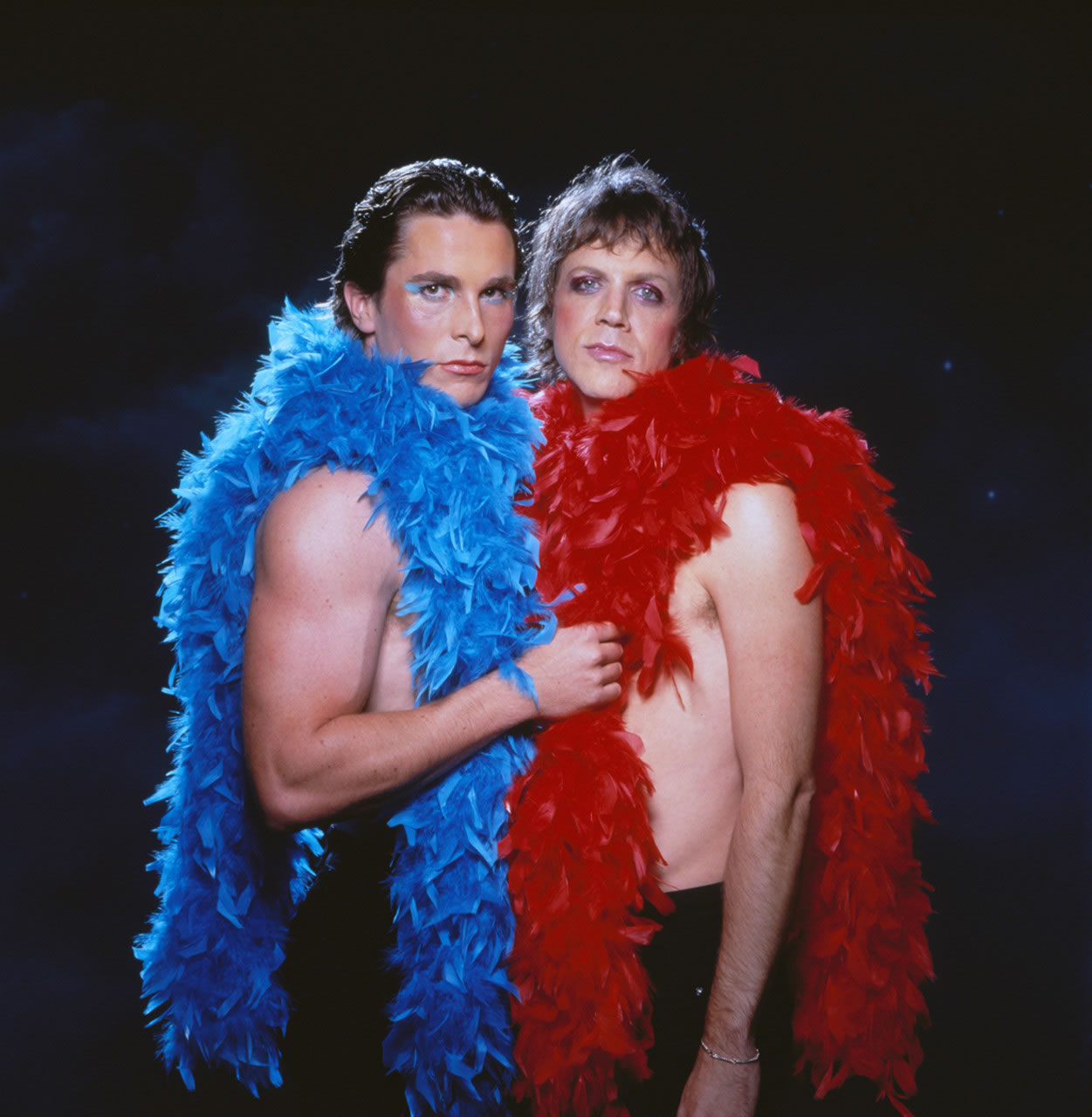 |
| Christian Bale and Todd Haynes |


