Showing posts with label Karen Black. Show all posts

Wednesday, June 03, 2015

Hitch's Final Plot


A celebrated director’s final film is rarely his or her most shining moment; most don’t end their careers on as high a note as Cecil B. DeMille (The Ten Commandments). No one cites Charlie Chaplin’s A Countess from Hong Kong or Billy Wilder’s Buddy Buddy among those auteurs’ greatest triumphs. Alfred Hitchcock’s last film may not be among the very best for the Master of Suspense, but the years have been kind to it. Viewed today, it’s a highly entertaining cap to one of the most brilliant careers in cinema. 

Though Family Plot (1976) is not in a league with the Master’s prodigious catalog of masterpieces— including but not limited to RebeccaRear WindowVertigoNorth by NorthwestPsycho and The Birds—it’s arguably as good as lesser efforts such as I ConfessStage Fright, Torn Curtain and Marnie. Hitchcock’s swan song is at turns mystery adventure, psychological thriller and comedic romp. His penultimate film, 1972’s Frenzy, had featured no recognizable box-office stars in its cast, and its frank treatment of a British serial killer’s sexual perversions and violence was not an audience pleaser (though remarkably ahead of its time and now a cult classic). 

For Family Plot, Hitchcock returned to a more middlebrow, tried-and-true formula that includes charismatic stars, romance, dark humor and a diamond heist subplot as its de rigeuer “MacGuffin” to add some sparkle to the proceedings. (The MacGuffin is, of course, a plot device that acts as a catalyst for the protagonist’s journey, often unimportant to the overall storyline, used most famously and pointedly by Hitchcock.)

The wonderful Barbara Harris
Family Plot is dominated by a delightfully zany performance by the brilliantly quirky Barbara Harris (Freaky FridayNashville) as a phony psychic who sends her detective boyfriend (a surprisingly likeable Bruce Dern) on wild goose chase to find a missing heir and claim a $10,000 reward. Harris, a Method actor and stage veteran (On a Clear Day You Can See Forever)  whose star rose and burned briefly in the 1970s, is one of Hollywood’s forgotten stars now, but every film performance she gave us is a gem. This is no exception, and she displays real chemistry with Dern, better known for playing dark and troubled characters (Bloody MamaComing Home) but refreshing and winning here as a charming average Joe. (Dern had played a bit role in Hitchcock’s Marnie 10 years earlier.)

Barbara Harris and Bruce Dern
Cathleen Nesbitt (An Affair to Remember) is effective as the elderly spinster who sets the search for her long-lost nephew into motion. William Devane, a ubiquitous TV presence in the 70s and 80s, is appropriately oily and menacing as the avaricious kidnapper, jewel thief and cold-blooded murderer who turns out to be the one they’re all looking for. Reliable character actors like Ed Lauter (Thirteen DaysThe Artist), Katherine Helmond (Soap, Brazil) and Marge Redmond (The Trouble with Angels) make the most of their somewhat oddball bit parts, giving the story dimension and color. 

Cathleen Nesbitt

Ed Lauter and Katherine Helmond
Also a standout is Karen Black as Devane’s paramour and partner in crime, who transforms herself into a mysterious blonde to aid him in his dastardly doings. (Note the tongue-in-cheek reference to the director’s own “Hitchcock blonde” motif.) Strangely, this final Hitchcock also happens to be one of Black’s last “A” pictures. After her star-making turn in Five Easy Pieces, she reached her career peak right here in the mid-’70s with performances in The Great Gatsby and Day of the Locust. But beginning with Airport ’75 and Trilogy of Terror, Black had already begun to slide into the abyss of the grand guignol, with more horror films to her credit than anything else. Her turn here as a Hitchcock femme fatale is a memorable one. 

Karen Black

William Devane and Karen Black
Harris, Black and Dern, exemplifying the “new breed” of 1970s actors, lend a contemporary edge to this basically old-fashioned film. (Harris and Black also appeared together in Altman’s masterpiece Nashville, and Dern acted opposite Black in The Great Gatsby.) In an attempt to be hip and current, a few four-letter words are thrown in, as well as humorous allusions to Harris’s and Dern’s spasmodic sex life. (They rock it on a waterbed, but alas, offscreen!) 


But of course, there are also moments of classic Hitchcock suspense...particularly the chilling sequence where Dern realizes his brakes have been tampered with as he and Harris careen down a mountaintop, and she claws at him for dear life. 

Hitch's last cast
Hitchcock was 75 when he directed Family Plot. He died just five years later, but lived to see Mel Brooks’s hilarious and affectionate spoof of his greatest films, High Anxiety (1977), which Brooks proudly showed to Hitchcock in a private screening. Hitchcock approved heartily, because, after all, in Hitch’s own words, “Every film I made was a comedy.” 


Saturday, August 17, 2013

Many Thanks, Robert Altman, Robert Altman


A crumbling relic of the past, which was never built to be anything but a facade in the first place, is far from a foundation on which to base a life and an identity. That’s the theme of Come Back To The Five and Dime, Jimmy Dean, Jimmy Dean, the little-seen 1982 film based on a play by Ed Graczyk and directed by Robert Altman. Currently unavailable through any mainstream DVD-on-demand service, lovers of this film must content themselves with scratchy VHS transfers offered by those lucky enough to buy the film when it was still in circulation more than two decades ago. (And thank goodness for that crumbling relic of a videotape which allowed this film lover to enjoy this remarkable little film once again.)


Black, Bates and Cher—Disciples of James Dean
A quirky piece, even for the king of quirk himself, the great Robert Altman (M*A*S*H, The Player), Come Back To The Five and Dime, Jimmy Dean, Jimmy Dean is a forgotten gem of a film, featuring a collection of strong and dimensional women’s roles brought to life by an eclectic group of fine actors. Here is where film fans will find Sandy Dennis in her last great role and superstar Cher in her first, plus startling turns by a young Kathy Bates, Marta Heflin, and a Karen Black as you’ve never seen her before.


Sudie Bond, Sandy Dennis and Cher
Based on a 1976 play by Ed Graczyk, Jimmy Dean takes place in a dusty and arid one-horse Texas town several hundred miles from Marfa, where scenes from the 1956 George Stevens epic Giant were filmed. It is now two decades since these local Texans experienced their brief brush with Hollywood magic, and the members of a local fan club, the Disciples of James Dean, are scheduled to meet at the local dime store where they originally held their meetings, 20 years after Giant and the young star’s untimely death. All that's left of the past are crumbling bits of the fictional Reata Ranch, which Mona collects during a yearly pilgrimage to the long-abandoned film location.


By the late ‘70s, the “well-made play” as popularized by Ibsen and continued by Tennessee Williams and William Inge had fallen out of favor, and Graczyk’s play was considered old-fashioned and derivative with its rhythmic and formulaic uncovering of secrets and revelations, culminating in a transformational climax, but within this well-worn structure actors are allowed to shine.

Edna Louise (Heflin), Mona (Dennis) and Juanita (Bond)

Mona, Joe (Patton) and Juanita

A tense moment for Mona, Joanne and Sissy
Lacking the operatic and often Shakespearean spectacle of Robert Altman’s most well-known films, this one is a curiousity, with its claustrophobic single setting of a faded drugstore interior sweltering in a Texas heatwave. Altman also uses the stage conventions of lighting and the reflection of a mirror behind the counter to differentiate the 1955 flashback scenes with the present action. But fans of the filmed stage play genre will appreciate Robert Altman’s loving focus on his actors. Having also directed the play on the Broadway stage with the same cast, the director chooses to allow them to tell the story.

Sandy Dennis as the high-strung Mona
As the troubled and dreamy Mona, chosen as an extra for a few of Giant’s large crowd scenes and still starry-eyed from her mythic encounter with James Dean, Sandy Dennis gives one of her most layered and complicated performances. Look up the word neurotic in the dictionary and you’re bound to find a picture of Ms. Dennis in any of her iconic film performances, perhaps in her Oscar-winning turn as Honey in Who’s Afraid of Virginia Woolf, or as Jack Lemmon’s beleaguered wife in Neil Simon’s The Out-of-Towners. Mona is a crowning achievement for Dennis, who did very few films after this one.

Karen Black reveals an uncomfortable secret as Joanne
The versatile Karen Black, who worked so well with director Altman in the legendary 1975 country music epic Nashville, gives one of the most arresting performances of her career in the difficult role of Joanne, the transsexual visitor who serves as catalyst for the destruction of Mona’s fragile facade of untruth. Joanne’s “Edie GormĂ©” monologue, delivered while perched against the rusted jukebox, is an iconic moment for Karen Black fans.

Cher's acting debut, as the sassy yet vulnerable Sissy
Jimmy Dean also marks the film acting debut of Cher—no, her appearances with Sonny in specialty movies Good Times and Chastity don’t count! Already a seasoned performer, Cher makes the transition from musical variety to drama seamlessly and skillfully, recreating her stage triumph as the brassy, bawdy and big-bosomed Sissy.


The smaller roles are standouts, too, particularly plaintive-voiced veteran character actress Sudie Bond as Juanita, the hyper-religious proprietress of the drugstore; Altman stalwart Marta Heflin as a shy wallflower, and Kathy Bates as her pushy, loud-mouthed former BFF. The only male role in the story, their gay friend Joe, is played in the flashbacks by Mark Patton. Unseen by the audience is the title character, the supposed offspring of Mona and the movie star, a half-wit who became a cause celebre when used to promote Texas tourism after James Dean’s sudden death.

Watching these wonderful actors work together under the direction of a creative risk-taker like Altman is a joy. Even if this film is ultimately deemed a failure by film historians, it’s an experimental work of of movie art designed for lovers of acting and theatrical storytelling.  


Robert Altman with his stars 
"Sincerely" by the McGuire Sisters

Thursday, June 13, 2013

Once Burnt...


The haunted house is a common theme in horror movies, but this little-known gem from the 1970s is among the most terrifying of the genre.

In Burnt Offerings (1976), a young family are offered a charming but somewhat dilapidated Long Island estate for the summer at an attractively low price. It seems ideal, even if the owners—a pair of elderly siblings—are eccentric and the house needs a lot of loving care.  But there’s a reason for the low rental price: The mother of the two old-timers is still alive and living upstairs in the attic, and will need three meals a day brought to her on a silver tray. Nevertheless, they can’t resist the idea of living in this grand house with its extensive grounds and swimming pool in need of renovation. They agree to the terms.

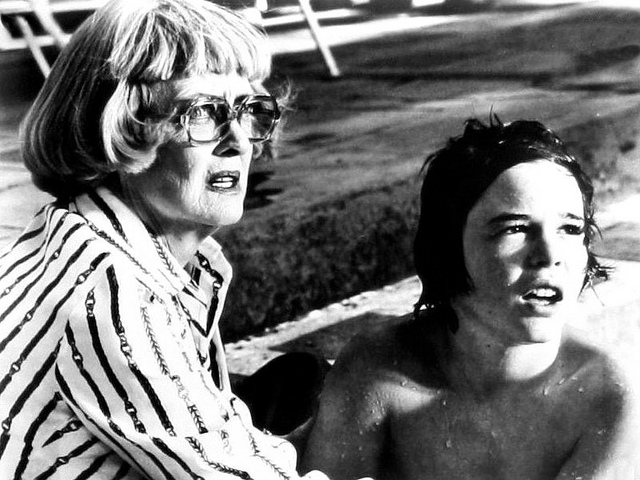
The cast is first-rate. Oliver Reed is Ben Rolf and Karen Black is his wife, Marian. Lee H. Montgomery is their 11-year old son Davey. Feisty, cigarette-puffing Aunt Elizabeth is played with precision by a mature Bette Davis. The Allerdyces are portrayed by veteran character actors Burgess Meredith and Eileen Heckart. 


As the summer progresses, the Rolfs freshen up the premises, restoring the swimming pool in the process. But the house slowly and inexorably sucks the life out of its inhabitants. Energetic Aunt Elizabeth becomes old and tired and feeble. Karen Black becomes obsessed with cleaning and polishing every knickknack in the house as if it were own, totally ignoring the needs of her family. Oliver Reed is tortured by horrifying dreams, becomes psychotic and almost drowns his son. They realize they need to leave this terrible place—if only old Mrs. Allerdyce (unseen by everyone but Marian) were not upstairs!

Produced and directed by Dark Shadows creator Dan Curtis, Burnt Offerings foreshadows Kubrik’s The Shining a few years later, as Oliver Reed’s character degenerates into madness in an isolated setting.

Eerie and spooky throughout, a few sequences hit the top of the shock-o-meter: Oliver Reed’s terrifying dream of a demonic chauffeur at his father’s funeral becomes reality as the apparition becomes the angel of death, stalking and scaring ailing Aunt Elizabeth to death. And the revelation of the identity of old Mrs. Allerdyce provides a jolt on a par with the climax of Hitchcock’s Psycho.

I saw this movie with my father when I was 10...and had to revert to sleeping with a night-light for months to come. Even though I now own it on DVD, I hesitate to watch it alone in the house.