Tuesday, January 12, 2016

A Goldmine of Glam


The recent death of music legend David Bowie at the age of 69 signaled the end of an era; the loss of a great talent and one of the most influential pop culture icons of our time. Though he was 69, the youthful, impish Bowie appeared never to have grown old. To the end, he remained a music industry sex symbol, ever hip and au courant.

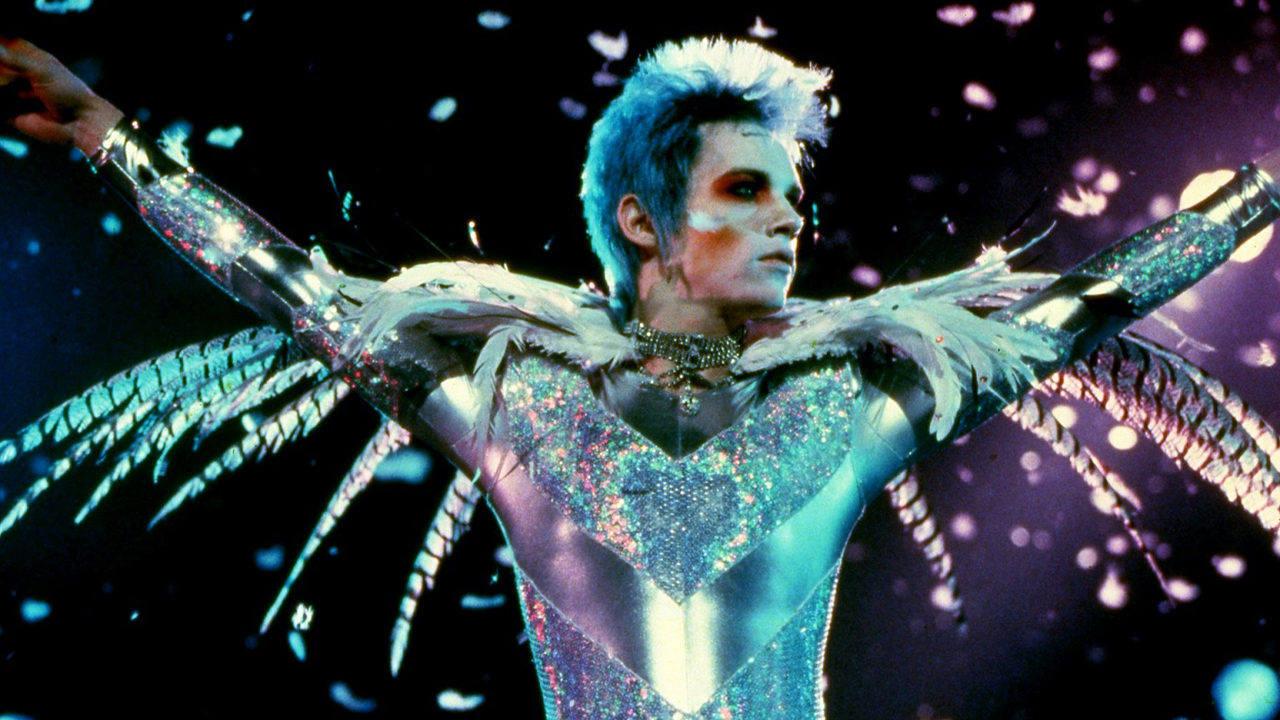
Bowie was the chief inspiration of master filmmaker Todd Haynes for his glam rock fantasia Velvet Goldmine (1998). Goldmine traces the life of a famously bisexual pop star as seen through the eyes of one of his fans, once a London mod rocker and now a tabloid writer in a grim, gray 1984 New York that is positively Orwellian in its dull conformity, devoid of color and imagination. But the joy and excitement of that glittering bygone era are eternally incandescent. 

David Bowie as Ziggy Stardust

Much of the film is gleaned from the story of a working class London lad who turned pop culture on its ear with his bold androgyny and visions of space-age grandeur. Haynes was largely inspired by David Bowie’s Ziggy Stardust albums, relying upon many of Bowie’s songs and lyrics to tell the story in the first draft of his screenplay.

The character of Brian Slade aka Maxwell Demon is an obvious homage to the Ziggy Stardust alter ego of notorious showbiz chameleon Bowie. (Indeed, one of Maxwell Demon’s incarnations is a glitteringly reptilian sex symbol of a lizard.) Later, when it’s revealed that Slade has become the toothsome 1980s pop star Tommy Stone, we’re reminded of Bowie’s clean-cut, tuxedo-clad, commercially successful “Let’s Dance” career phase.  

Jonathan Rhys Meyers as Brian Slade

But David Bowie was of zero help to Haynes, refusing to allow the filmmaker to use any of his songs in the film and forcing Haynes and his the creative team to search frantically for music (both old and new) that would fulfill Haynes’s vision and aid the narrative.

The roadblock turned out to be a creative challenge that Haynes and company turned into a triumph. Musical contributors to the soundtrack included Lou Reed, Brian Eno, Bryan Ferry and members of The Stooges, Radiohead, Roxy Music and Sonic Youth. The songs used in Goldmine work perfectly in the scope of this epic film. That most are not so well known turns out to be a plus. 
"For once there was an unknown land, full of strange flowers and subtle perfumes, a land of which it is joy of all joys to dream, a land where all things are perfect and poisonous..."

The unfamiliarity of the songs allows the music itself to take a secondary role to the thrust of the narrative. The film’s rich imagery and spectacle, and most importantly, its multilayered storyline, complex characters and relationships (and unforgettable performances) take center stage. In Velvet Goldmine, Haynes strikes gold with his own inventive, exciting, touching and absorbing storytelling. (And ultimately, the movie soundtrack has proven to be musically memorable as well in the years since it was first released. )

Made in the U.K., Goldmine has the feel of an authentically British film of the early 1970s, springing from the mind of a very inventive American writer and director. An exhaustive researcher who immerses himself in his subject matter and excels at period pieces, Haynes helmed the brilliant miniseries of Mildred Pierce, and the Douglas Sirk homage Far From Heaven as well as the recently acclaimed 1950s lesbian drama Carol. 

Christian Bale as Arthur Stuart

In Goldmine, Haynes and his team accurately recreate mod London at the crux of the swinging sixties into the superstar seventies. Oscar-winning costume designer Sandy Powell (Shakespeare in Love, The Aviator) and production designer Christopher Hobbs and art director Andrew Munro reveal their penchants for painstaking period detail, as well as a talent for wildly imaginative tableaux and scenarios for the dreamlike musical sequences.

Velvet Goldmine perfectly captures a particular moment in music history, but it is so much more--it’s a sprawling masterwork on the nature of art itself. Haynes, not content with capturing the glitter rock era alone, reaches all the way back to the legend of Oscar Wilde and the English music hall era for evidence of primitive precursors of “glam”, and propels us forward into outer space and other dimensions of reality to flesh out his themes on the origins of art, creativity and freedom of expression. It’s a visual, intellectual and musical feast. 

Toni Collette as Mandy Slade
There are too many dazzling and dizzying moments in Velvet Goldmine to describe them all, but a few of its more intimate moments reveal the film’s unique spirit and intentions. The glammed-up Ken dolls used to portray some of Curt and Brian’s intimate private moments (as imagined by their young fans) is storytelling innovation at its best, and a brief homage to Haynes’s own Karen Carpenter Story (in which he told the entire story of the bulimic singer’s tragic life using Barbie dolls). 

"The Ballad of Maxwell Demon" album

The sequence in which Arthur purchases the “Ballad of Maxwell Demon” record album and lay on the floor of his room with soda and chips to listen, flipping through a fan pop magazine, is particularly evocative of a long-ago 1970s teenage ritual. The album lays open on the floor beside him, the lush, erotic photography and music taking him on a romantic flight of fancy. Somehow, Haynes manages to capture the feel and even smell of the vinyl, and the once-familiar “pop” of needle hitting record as the music begins on the hi-fi.

Ewan McGregor as Curt Wild

The film owes as much to its wonderful cast as to its innovative production design and literate script. Jonathan Rhys Meyers, (just 23 when he undertook this career-making role) is chillingly effective as icy pop prince Brian Slade, who must fake his own death in order to rid himself of the Maxwell Demon persona. Indeed, Brian is ruthlessly ambitious and cold as ice as he drops his kindly first manager (Michael Feast) without a qualm in order to climb the ladder to legend and infamy. (Later, he’ll ditch his wife Mandy as well with the same calculated coldness.) But his moments of love and creative collaboration with troubled, talented Curt Wild, though all-too-brief, softens the hard-edged character somewhat.

Toni Collette (The Sixth Sense, United States of Tara)  makes an indelible impression as the outrageous party girl Mandy, obviously based on Angela Bowie, who encourages Brian to push the envelope with a flamboyant and sexually fluid public image.

The character of Mandy was based upon Angela Bowie

Ewan McGregor is wonderfully vulnerable as the burnt-out, drug-addled Curt Wild (loosely based on Iggy Pop), and gives a surprisingly powerful musical performance as well. He enjoys great chemistry with Rhys Meyers. (The fictional coupling of Curt and Bryan is equally based upon the reported real-life hookup of Bowie with Mick Jagger.) 

Eddie Izzard as Jerry Devine
Eddie Izzard is perfectly cast as the slimy Jerry Devine, who capitalizes on the young musician’s androgyny to create the commodity known as Brian Slade aka Maxwell Demon.  

As Arthur Stuart, Christian Bale has one of his most affecting and down-to-earth roles, convincingly playing a gay character without a trace of cliché or mannerism. It is he who must retrace his own teenage years to uncover the secret of Brian Slade. From shy teenager who makes a brief connection with rock star Curt Wild after the historic “Death of Glitter” concert, to world-weary investigative reporter in a Brave New World, Bale’s everyman Arthur is the glue that holds the story together. 

The creation of a pop idol

This could actually be Todd Haynes’s most original and personal film, with profound truths lurking beneath the glitz and spectacle. He highlights the ruthlessness of talent, fame and performance; the necessary sacrifice of peace, serenity and normalcy, the need to continue to move on and reinvent yourself in order to survive in a tough, competitive, ever-changing world. Beauty is pain in the showbiz pantheon. But we cannot live without art and beauty. And Curt Wild and Arthur Stuart represent the eternal hope of the romantics, cherishing the quieter moments of intimacy and self-discovery...for there is magic there, too. 

"Come closer. Don’t be frightened. What’s your name? Your favourite colour? Song. Movie. Don’t be nervous."
Even without any of the rock star’s iconic music, this film will be forever linked with the legend of David Bowie, who almost singlehandedly exemplified the short interlude in music history known as glam rock. In later years, it’s said, David Bowie privately gave his stamp of approval to Velvet Goldmine, agreeing that it satisfactorily captured the creative vitality and poetic spirit of an era he was instrumental in creating. Director Todd Haynes must have beamed when he heard that. 
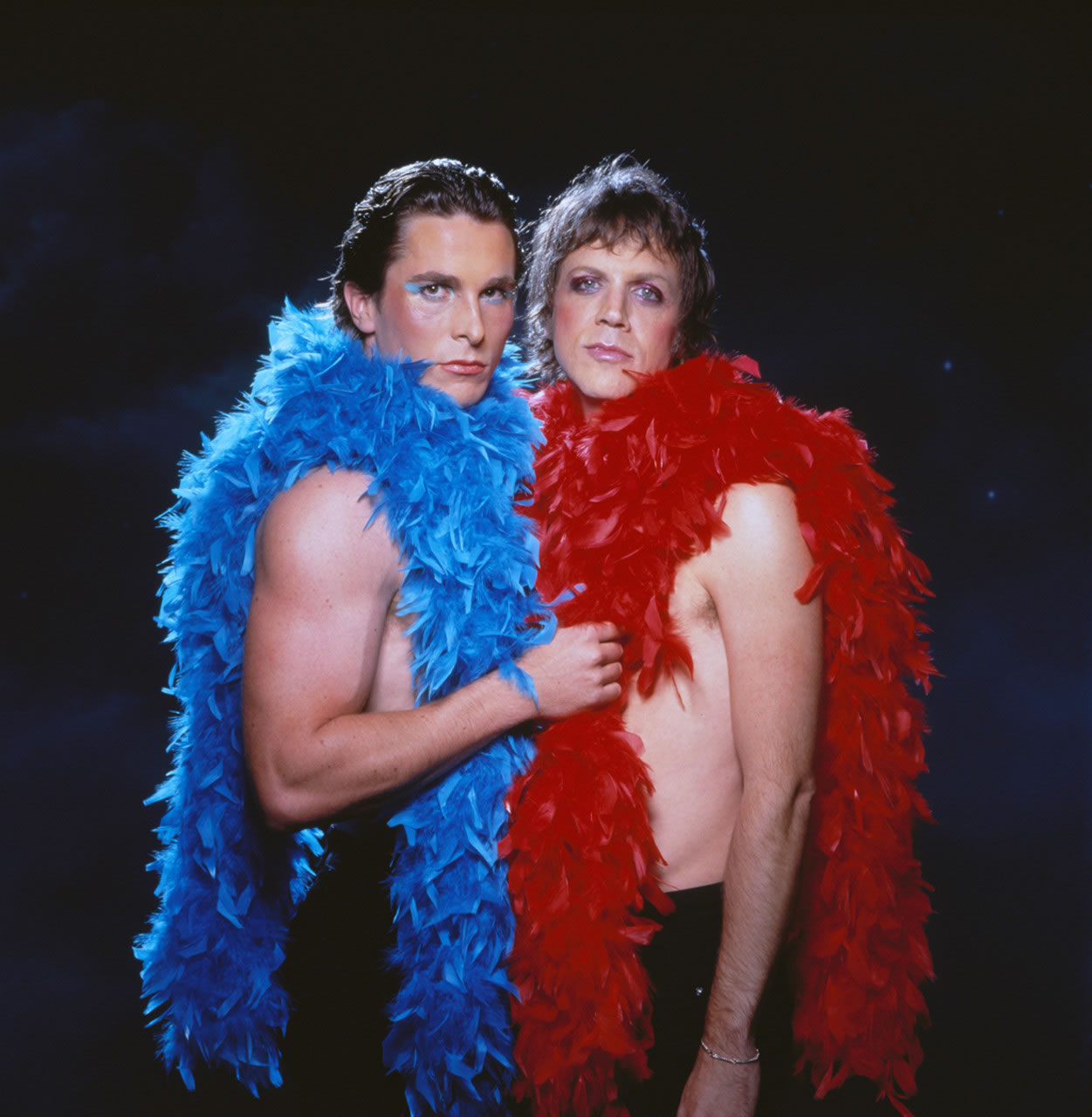
Christian Bale and Todd Haynes

Wednesday, January 06, 2016

I Want My Mommie!


Reading Rutanya Alda’s recent book on the making of Mommie Dearest (1981) triggered me to take an umpteenth look at a fascinating film that never gets old to me, and an iconic star performance by Faye Dunaway that forever changed the trajectory of her career.

In her personal diary of the filming of this camp opus, Alda, who played the downtrodden and underappreciated secretary/companion Carol Ann to Faye Dunaway’s Joan Crawford, weaves an absorbing tale of neurotic and insecure actors (including dear Rutanya herself!), overworked technicians and designer divas (all as high-strung as the star, in fact). She paints Dunaway as the consummate narcissist, totally engrossed in her own performance to the detriment of the overall production. (Alda’s wry reflections are also a general indictment of how cold the movie business can really be.)


And at the end of her book, Alda confides that Dunaway herself is planning to publish her own Mommie memoir—and even asked Alda to help her write it (as if Carol Ann was still her faithful handmaiden).  Fanatic lovers of the cult classic are waiting with bated breath to hear her side of the story, as the actress has steadfastly refused to discuss the film at any length, indeed flying into a rage at the mere mention of Mommie.

Alda’s memoir is a great read, but there are so many unanswered questions that only Miss Dunaway can answer. Was Anne Bancroft really the first choice to play Joan? What were the original creative intentions of this film? Did they expect it to be taken seriously by critics and audiences? What in the world did the creative team think they were creating? Perhaps Faye will give us a clue, if she ever follows through with her own book.

According to Alda, Faye was convinced that the role of Joan Crawford would bring her another Academy Award nomination (“I won’t win it, though,” Dunaway added with false modesty.)
Day after day of obsessively running the dailies, poring over every foot of film shot, how could Faye Dunaway not know that both her performance and her appearance were an over-the-top cartoon?

Dunaway 1967—bigger than Jennifer Lawrence is today
Undeniably, Faye Dunaway was a fine actress of rare beauty and megawatt star power, the Jennifer Lawrence of her day. Her startling breakthrough role opposite Warren Beatty in 1967’s acclaimed Bonnie and Clyde brought her an Academy Award nomination for Best Actress, as did her turn in Roman Polanski’s homage to 1940s noir, Chinatown (in which Dunaway pays homage to The Maltese Falcon’s Mary Astor as the inscrutable seductress). In 1976, her realistic portrayal of an ambitious TV executive in Paddy Chayefsky’s chilling satire Network won her the coveted Oscar. Throughout the 1970s she costarred with Redford, Nicholson, Newman, McQueen. She was A-List all the way.

How could she have taken such a wrong turn with Mommie Dearest? What were the filmmakers intending? Was it some sort of creative experiment gone horribly bad? Were she, director Frank Perry, producer Frank Yablans (The Other Side of Midnight) and executive producer David Koontz (Christina Crawford’s husband) deliberately creating an overblown, surreal and cinematic biopic as an homage to Crawford’s famously mannered performances in iconic melodramas? Therein lies the mystery not solved in Rutanya Alda’s diaries.

Diana Scarwid as Christina; Faye and an overpowering bouffant as Mom
Producer Yablans had assembled a glittering production team to create a sumptuous period piece, recreating old Hollywood glamour of the 1940s and 50s—most notably Oscar-winning costume designer Irene Sharaff, who dressed Crawford herself, as well as Judy Garland, Elizabeth Taylor and Doris Day back in filmdom’s golden era; and production designer Bill Malley, who created the eerie look and feel of The Exorcist. The period costumes and sets were all first-rate and authentic, and early photographs of Faye as Joan (taken by Dunaway’s photographer paramour Terry O’Neill) were leaked to the press. The likeness would be uncanny, everyone thought.

But ultimately, according to Rutanya Alda’s book, the hair and makeup team quickly became fed up with Dunaway’s perfectionism, and the actress’s resulting looks suffered tremendously in the translation. Irene Sharaff also quit the production in a huff after a tiff with Dunaway. The script, originally adapted from his wife’s book by David Koontz, was tinkered with by a laundry list of writers of various styles and points of view. The shooting schedule of the film was demolished by poor time management, and many scenes were never shot, others filmed but never used. (Such is undoubtedly the case with many films.)

Mommie’s supporting cast, led by Mara Hobel as the younger and Diana Scarwid (Inside Moves, Silkwood) as the older Christina, are poorly developed (though those actresses do both give it their all opposite Faye), and in the final cut Rutanya Alda’s faithful servant Carol Ann is barely a cipher (and her horrific old age makeup is the pits!).  As a result, it was solely up to the star power of Faye Dunaway to carry the film. (And she runs away with it—but at what cost?)

Severe, taken to the extreme 
In many ways, it’s a monster movie, on a par with Godzilla or Frankenstein. In an early scene, Dunaway as Crawford walks into her foyer to greet her boyfriend, lawyer Greg Savitt (Bautzer to true Crawford historians), played by Steve Forrest. The camera moves in on Dunaway, looking quite attractive, but then in the close shot, we see her beauty marred by comically painted-on, caterpillar-width eyebrows. (Yes, that may have been the style in 1940, but it strikes one of the first jarring notes in this 1981 symphony of cinema dissonance.) The greatest drag show on earth has begun.

Dunaway allows herself to become more and more unattractive as the film goes on, wearing a series of wigs and hairstyles that are either severe or overwrought but always unflattering. Her grinning painted-on face leers underneath a tight white swimming cap in the pool sequence, transforming her from glamour gal to an evil, demonic clown. Most famous is the night raid sequence, where a drunken Joan bellows like a harridan about wire hangers in her daughter’s closet, then beats her with both a hanger and a can of Bon Ami cleanser. Dunaway’s horrifyingly insane-looking, cross-eyed face glinting under a thick layer of cold cream is iconically nightmarish.

Deep in character for the night raid scene
Faye Dunaway’s performance is histrionic, to put it mildly, positively operatic in its range and scope. (Faye herself described it as a Kabuki during a brief discussion of the film on Inside the Actor’s Studio.) She paints a no-holds-barred portrait of a monstrous shrew, evoking a tempest of trumped-up emotions and theatrical gestures. Unfortunately, there’s precious little heart or depth, and few quiet or introspective moments to offset the unrelenting bombast. Director Perry fails to pull Dunaway back from the precipice of ridiculous overacting, and the actress just simply takes the plunge into the grand guignol. (And truly seems to glory in it). 

Mommie Dearest, after receiving excoriating reviews and being branded an ignominious flop upon its release,  was immediately elevated to cult status by the gay community—and there it remains, where countless thousands of other films have disappeared from public consciousness. And generations of gay fans have applauded Faye’s balls-out performance as her most fabulous, fearless and unforgettable screen creation. The film has become an obsessive guilty pleasure, a gleeful happening on a par with The Rocky Horror Picture Show, a repetition ritual to be experienced over and over until every line and gesture is memorized and indelibly inscribed upon the psyche. 

A beauty-in-a-turban moment for Faye, and the real Joan Crawford

Faye’s A-List career never quite recovered despite creditable performances in dozens more films over the years. But her reputation was tarnished, and the characters of Joan/Faye seemed to blur as coworkers stepped forward to name Dunaway as a real-life diva who was as much a horror as the Mommie character she had created.

Bette Davis and Roman Polanski had both named Dunaway as the most difficult actress they had ever worked with, and Rutanya Alda’s tales confirm that Faye was indeed demanding, self-absorbed and contrary as she created the character of Crawford, always failing to connect on a human level with the other actors in the film. (Reportedly, she’d reblock entire scenes, pushing the supporting characters out of the camera frame whenever possible, commandeering and appropriating their lines, and insisting that no crew member be in her line of vision when the cameras were turning.)

But isn’t every great star a little bit of a monster? Don’t they all have to be tough cookies, to succeed in the hyper-competitive business of show? Ambition, self-preservation, immersion in craft and character, a ruthless determination to compete and come out on top...undeniably all the ingredients needed to obtain and maintain a firm footing in the quicksands of the cinema firmament. Faye had ’em all.

Miss Dunaway, we eagerly await your side of the story. In the meantime, we will always love you, Mommie Dearest! (And three cheers for Carol Ann!)

P.S. Read more about Rutanya Alda's book at Le Cinema Dreams. 


Thursday, December 24, 2015

All About Showbiz Evil

Making it to the top of the heap in the show business world requires guts, stamina, talent, and above all, determination and ambition. Is it any wonder that All About Eve is the quintessential Bette Davis movie, as well as the ultimate backstage soap opera? 

Merrill, Davis, Sanders, Baxter, Marlowe and Holm—a powerhouse cast

Based on a 1946 Cosmopolitan magazine article, “The Wisdom of Eve” by Mary Orr and reportedly inspired by true events, All About Eve has a simple and timeless plotline: A mature actress’s career and relationships are threatened by the machinations of a scheming young acolyte.  

It’s incredible that Davis was not the first choice to play Margo Channing. Indeed, the great Claudette Colbert had signed on to play the role, but she fractured her back and was unable to rise to the occasion. But it’s hard to imagine the calm, cool and collected Colbert performing Margo’s iconic set pieces-- getting drunk and belligerent at her own cocktail party, or screaming like a fishwife at her younger director paramour. With Claudette, it would have been a different character and film entirely, and we can assume writer/director Joseph L. Mankiewicz tailored the role to suit the talents of the more histrionic Davis. 

Bette Davis as Margo Channing
Colbert’s misfortune was a big break for Davis, whose career had recently hit the skids after more than 15 years as reigning queen of the Warner Brothers lot. By the late 1940s, the choicest female roles were now being offered to Warners newcomer Joan Crawford. (Davis had actually turned down the role of Mildred Pierce.) 1949 had been a nadir. After appearing in the tepid melodrama Beyond the Forest (in a black fright wig, no less), Bette’s best days seemed to be behind her. Until Eve--and the glorious Margo Channing. 

Anne faces off with Bette, as Marilyn, Hugh and company look on

Bette imbues the role of Margo with her own unique brand of piss and vinegar. Like Davis herself, Margo is a tough broad, a big personality, but she just as successfully reveals her character’s vulnerability and neuroses in her multi-layered performance. In every scene, Davis dominates, pulling out all the stops to give this iconic, tour-de-force performance. (In fact, poor Anne Baxter, playing the title role, sort of fades into the background in her few face-to-face scenes with Davis.)

Eve revitalized Bette’s career, but she did not win the Oscar that year. Davis was nominated opposite costar Anne Baxter and Gloria Swanson’s acclaimed comeback role in Sunset Boulevard, but despite (or maybe because of) all this dramatic star power, the Oscar ultimately went to comedienne Judy Holliday for Born Yesterday. (Eleanor Parker was nominated that year, too, for Caged, not that anyone remembers!)

But Bette did not triumph alone. All the leading performances in Eve are essayed by skilled actors in their prime and pack a powerhouse punch, bringing writer/director Joseph L. Mankiewicz’s sparkling screenplay to life. 

Chilly: Karen (Celeste Holm), Margo (Bette Davis) and Lloyd (Hugh Marlowe)

Celeste Holm brings warmth and humanity to the film as Karen Richards, wife of celebrated playwright Lloyd, with “no talent to offer, except for loving her husband.” Though Holm was well-known to be something of a grand diva herself, here she’s down to earth as Margo’s best friend. (Davis and Holm were not at all friendly in real life, despite their onscreen chemistry. According to Holm, her cheery “good mornings” to Davis on the set would always be met with stony silence.)

B movie actor Hugh Marlowe (who years later found a home on television on the long-running soap opera Another World) enjoys his most high-profile film role as playwright Lloyd Richards. His shouting match with Bette Davis across the theater is one of the film’s most well-written and well-played scenes: “All playwrights should be dead for two hundred years!”

Gary Merrill is perfect as the passionate theater director who espouses a high-minded philosophy of show business and the peculiar breed of people attracted to it: “All of the religions of the world rolled into one.” During the filming, Davis and Merrill fell in love offscreen, too, and were married for 10 tempestuous years. (Like Richard Burton and Elizabeth Taylor after Who’s Afraid of Virginia Woolf, the Davis-Merrills couldn’t seem to stop playing the argumentative characters they had perfected even when the cameras weren’t turning.)

Addison (George Sanders) advises Miss Casswell (Marilyn Monroe)

The ever soigné George Sanders won the Best Supporting Actor Oscar for his turn as the cynical and acerbic theater critic Addison DeWitt, who lacerates his opponents with his inimitable brand of erudite male bitchery. (Unhappy George, once married to an effervescent young Zsa Zsa Gabor, suffered from crippling depression and alcoholism, and took his own life in 1972.)

Anne Baxter—after the understudy's performance

Though the picture belongs in many respects to Miss Bette Davis, Anne Baxter does indeed have some unforgettable and well-played moments as the two-faced Eve Harrington (née Gertrude Slovinsky). Her best scene is in the powder room of the Cub Room with Celeste Holm, where Eve starts by apologizing tearfully but ends by attempting to blackmail Karen into giving her the starring role in Lloyd’s new play. Baxter also scores in her face-off with Addison DeWitt near the end of the film, sparring verbally with her acid-tongued benefactor before collapsing in a crumbling heap at his feet. 

The unforgettable Thelma Ritter as Birdie

Even the smallest roles are beautifully drawn and well-cast by Mankiewicz. The redoubtable Thelma Ritter is unforgettable as the sarcastic maid who is wise to Eve’s overweening ambition, stealing every scene she’s in. Gregory Ratoff is deliciously comic as the hypochondriacal producer Max Fabian. And in a small but showy early role, superstar-to-be Marilyn Monroe displays impeccable comic timing as the talentless but enterprising showgirl Addison DeWitt uses for arm candy. 

Joseph L. Mankiewicz
Eve is the film by which director/writer Joseph L. Mankiewicz will be forever remembered. A true film artist, he can be described as an undoubtedly straight man with a gay sensibility. (Indeed, he had a passionate affair with gay icon Judy Garland, who married two or three gay men herself.) He had a flair for bitchy, witty dialogue and strong female characters, and was as much a “woman’s director” as was the effete George Cukor. Mankiewicz brought out the best in every actress he worked with (including elevating Elizabeth Taylor to goddess status in Cleopatra). Some of his best films include A Letter to Three Wives, The Barefoot Contessa and Suddenly Last Summer. But All About Eve is his finest of all. 

Lauren Bacall as Margo, on Broadway in Applause
In 1970, the film was adapted into a Broadway musical called Applause, which won Lauren Bacall a Tony Award for her contemporary “mod” interpretation of Margo Channing. But Eve’s basic plotline, the ambitious newcomer out to supplant the established star, is still an archetypal trope pregnant with dramatic possibilities and can be seen in dozens of other films and plays of yesterday and today, from Valley of the Dolls to Showgirls, from All About My Mother to Black Swan.

Oh, I can’t wait to watch it...again. “Fasten your seatbelts...it’s going to be a bumpy night…”